
Play Triple Diamond Now!
Home → Strategy
Triple Diamond Strategy
Approaching Triple Diamond sensibly
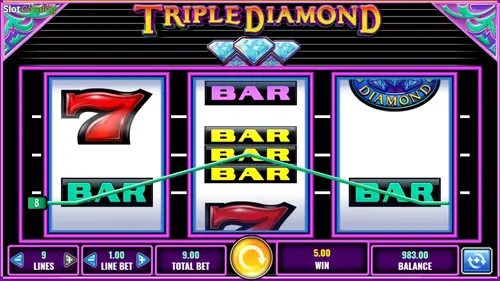
Triple Diamond is an online slot developed by IGT featuring a classic 3x3 reel layout with nine paylines. The theoretical RTP of 95.06% indicates a house edge of 4.94%, which is slightly higher than the 94.98% return of Wolf Run, another title by IGT. Players must understand that this percentage represents a long-run average over hundreds of thousands of spins rather than a guarantee for individual sessions. Consequently, short-term results will vary significantly from the mathematical expectation defined by the game engine.
The maximum win cap is set at 1199x the total stake, providing a clear upper limit for potential payouts on any single spin. This ceiling is notably lower than the 1000x max win found in Wolf Run, yet both games lack bonus rounds or free spins features. Understanding these constraints helps beginners manage expectations regarding large wins and realistic session outcomes. The absence of complex mechanics means players can focus entirely on the core spinning action without navigating intricate feature triggers.
Volatility is classified as low, meaning wins occur frequently but tend to be smaller in size compared to high-variance alternatives. This characteristic ensures a steadier bankroll erosion rate, allowing for longer playtime within a fixed budget compared to medium volatility slots. Beginners benefit from this structure as it reduces the psychological pressure of rapid fund depletion during early learning phases. The consistent payout frequency supports a more predictable gaming experience aligned with initial educational goals.
Bankroll rules that hold up
A dedicated bankroll is the specific amount of money set aside exclusively for playing Triple Diamond, separate from personal finances. With a theoretical RTP of 95.06%, the house retains 4.94% of all wagers over extended periods, dictating the expected loss rate. For example, wagering €100 results in an expected return of €95.06, leaving a statistical loss of €4.94. This calculation demonstrates why preserving capital requires strict adherence to predefined spending limits before opening the game interface.
Flat betting involves placing the same stake every round, which prevents rapid bankroll exhaustion common in progressive staking systems. Since Triple Diamond offers no cash-out button and is not a crash game, players cannot lock in profits mid-spin. The maximum win of 1199x applies only at the end of a completed sequence, making steady bet sizing crucial for longevity. Maintaining constant stakes aligns with the low volatility profile, ensuring funds last through the inevitable variance inherent in slot mechanics.
Comparing Triple Diamond to Wolf Run reveals similar risk profiles, as both are IGT titles with comparable RTPs around 95%. However, Wolf Run’s medium volatility suggests larger swings, whereas Triple Diamond’s low volatility favors gradual consumption of the bankroll. Beginners should allocate sufficient funds to withstand dry spells without deviating from their flat betting strategy. This disciplined approach mitigates the impact of the 4.94% house edge, extending entertainment value per euro spent.
Bet sizing against volatility
The triple diamond wild symbol substitutes for all other icons, creating multiplier effects that scale up to 9x on winning combinations. These multipliers apply directly to the base win, potentially turning small payouts into significant sums without altering the underlying volatility. A 9x multiplier on a standard win increases the payout immediately, demonstrating how feature mechanics interact with the low volatility setting. Players observing these events should recognize them as part of the designed return distribution rather than anomalies.
Wagering decisions must account for the 9-payline structure, where bets cover all lines simultaneously on the 3x3 grid. Staking too heavily accelerates bankroll depletion due to the 4.94% house edge accumulating across every spin outcome. For instance, a €10 bet yields an expected loss of €0,494 per spin, highlighting the cost of maintaining active participation. Adjusting stakes downward allows the low volatility to function effectively, smoothing out the variance between frequent small wins.
Unlike Wolf Run, which utilizes five reels and medium volatility, Triple Diamond’s three-reel setup simplifies bet analysis for novices. The reduced complexity means fewer variables influence each spin result, making the impact of bet size more transparent. Beginners can calculate potential losses more accurately by multiplying their stake by the house edge percentage directly. This transparency supports informed decision-making regarding how much to risk per spin relative to the total available bankroll.
The absence of bonus rounds or free spins means all returns come from base game spins enhanced by wild multipliers. This structure requires players to rely solely on the 1199x max win potential for substantial gains during a session. Progressive staking strategies fail here because they do not change the built-in edge and only shorten the time to ruin. Adhering to conservative bet sizes preserves the bankroll longer, allowing more opportunities to hit the high-paying wild combinations.
Session limits worth setting
Setting a time limit for playing Triple Diamond helps prevent fatigue-induced errors and excessive exposure to the 4.94% house edge. Low volatility games often encourage longer sessions due to frequent small wins, which can mask the cumulative effect of the RTP. By capping playtime, beginners ensure they do not lose track of the actual financial impact of the 95.06% return rate. This discipline protects the bankroll from slow erosion during extended periods of continuous spinning activity.
A loss limit should be established before starting, such as stopping after losing 50% of the allocated bankroll for the day. Given the maximum win of 1199x, chasing losses is mathematically futile and statistically unlikely to recover deficits quickly. Unlike Wolf Run’s medium volatility, which might offer larger intermittent payouts, Triple Diamond’s steady nature demands patience. Recognizing when to walk away prevents the common pitfall of trying to beat the system through increased wagering.
Win limits are equally important, as locking in profits after hitting a significant multiplier protects gains from subsequent losses. The 9x wild multiplier can create temporary surges in balance, but the low volatility ensures these rarely sustain indefinitely. Securing a portion of winnings maintains the integrity of the original bankroll for future sessions. This strategy aligns with responsible gambling principles by treating slot play as entertainment with a known cost rather than an investment vehicle.
Comparison with Wolf Run highlights different session dynamics, as its five-reel format may produce longer dry spells between wins. Triple Diamond’s three-reel simplicity offers quicker feedback loops, requiring stricter time management to avoid repetitive play. Beginners should monitor their emotional state alongside financial metrics, adjusting limits based on real-time performance data. This holistic approach ensures that session boundaries remain effective regardless of the specific game mechanics involved.
Why chasing losses fails
Chasing losses involves increasing bet sizes after deficits to recoup money quickly, a strategy doomed by the fixed 4.94% house edge. In Triple Diamond, each spin is an independent event with a 95.06% RTP, meaning past outcomes do not influence future results. Increasing stakes merely accelerates the expected loss calculated by the formula: Stake x 0.0494 = Expected Loss per Spin. This mathematical reality renders progressive staking ineffective against the built-in casino advantage over time.
The maximum win of 1199x represents the highest possible payout, but achieving it requires luck rather than strategic betting adjustments. Attempting to force a win through higher stakes ignores the low volatility design, which favors smaller, frequent payouts. Unlike crash games with cash-out buttons, Triple Diamond offers no control mechanism to secure partial profits mid-spin. This limitation makes recovery from deep losses statistically improbable, emphasizing the need for pre-set bankroll limits instead.
Comparing Triple Diamond to Wolf Run shows that neither game allows skill-based intervention to alter the RTP or volatility. Both are IGT products relying on random number generators, ensuring fairness but also preventing player manipulation of odds. Chasing losses in either title leads to faster bankroll depletion due to the compounding effect of the house edge. Beginners must accept that variance is uncontrollable, focusing instead on managing their stake size relative to their total funds available.
Triple Diamond: key facts
| Parameter | Value |
|---|---|
| Game | Triple Diamond |
| Studio | IGT |
| RTP | 95.06% |
| House edge | 4.94% |
| Volatility | low |
| Max win | 1199x |
| Reels | 3 |
| Paylines / ways | 9 |
Common systems and their limits
The theoretical RTP of Triple Diamond sits at 95.06%, establishing a fixed house edge of 4.94% that no betting pattern can eliminate. Unlike White Orchid which offers a 95.03% return, this slight variance does not alter the fundamental mathematical disadvantage for the player over time. Consequently, any system claiming to overcome this edge is mathematically impossible regardless of stake size or sequence.
Triple Diamond features a low volatility profile with a maximum win cap of 1199x, limiting the potential for large payouts compared to high-variance alternatives. This structural constraint means players will experience frequent but smaller wins, preventing the massive swings required by many progressive systems. The payout structure thus restricts the effectiveness of aggressive staking strategies during typical play sessions.
The game utilizes nine paylines across a classic 3x3 reel layout, ensuring consistent hit frequency without complex bonus mechanics. While IGT developed the title, its straightforward design lacks the multipliers found in more modern video slots like White Orchid. Players relying on complex trigger conditions for profit will find this limitation restrictive given the absence of free spins.
Flat betting explained
Flat betting involves wagering the exact same stake every round, maintaining a constant risk exposure throughout the session. For Triple Diamond, this approach aligns with the 95.06% RTP by ensuring each spin contributes equally to the long-term expected loss calculation. The strategy preserves bankroll stability because the variance remains predictable and manageable over hundreds of spins.
With a house edge of 4.94%, flat betting ensures that losses accumulate at a steady rate proportional to total turnover rather than erratic spikes. This method avoids the rapid depletion associated with raising stakes after losses, as seen in progressive strategies. The player retains control over session duration by keeping individual bets small relative to the initial deposit amount.
The maximum win of 1199x represents the highest possible return per line, achievable only when three Triple Diamond wild symbols align. Since the slot lacks bonus rounds, the outcome depends entirely on base game spins where flat betting provides consistent engagement. This simplicity suits beginners who wish to understand the game mechanics without managing complex bet adjustments.
Progressive staking risks
Progressive staking requires increasing the wager after every loss, aiming to recover previous deficits with a single win. In Triple Diamond, this method ignores the fixed 4.94% house edge, meaning each adjusted bet still carries the same mathematical disadvantage. The strategy merely accelerates the rate at which the bankroll diminishes during inevitable losing streaks.
The low volatility of Triple Diamond produces frequent small wins that rarely cover the exponentially growing bets of a progressive system. A player facing a median losing run will quickly exhaust their funds before hitting a result large enough to reset the cycle. This dynamic shortens the playing time significantly compared to flat betting with the same initial capital.
Unlike White Orchid which has medium volatility, Triple Diamond’s low variance does not provide the large outlier wins needed to justify risky progression. The 95.06% RTP remains unchanged regardless of stake size, proving that raising bets does not improve expected value. Players adopting this approach risk ruin faster due to the mismatch between stake growth and payout frequency.
What the maths actually allows
The 95.06% RTP indicates that for every €100 wagered, the game returns approximately €95.06 over an infinite number of spins. This figure represents a theoretical average derived from millions of simulations, not a guarantee for any single session or day of play. Understanding this metric prevents unrealistic expectations about short-term profitability or guaranteed recovery of losses.
A house edge of 4.94% defines the casino’s statistical advantage, ensuring long-term profitability for the operator regardless of individual outcomes. This percentage applies uniformly to all bets placed on the nine paylines, whether the stake is minimal or maximal. The mathematical expectation remains negative, making sustained winning impossible without external bonuses or promotional credits.
The maximum win of 1199x sets a hard ceiling on potential payouts, capping the upside potential for any single winning combination. This limit contrasts with higher-variance games that allow uncapped jackpots, reducing the appeal for players seeking life-changing sums. The structured payout table ensures predictable returns aligned with the low volatility classification provided by IGT.
Reading variance honestly
Low volatility in Triple Diamond means wins occur frequently but are typically small relative to the total bet size. This characteristic reduces the severity of drawdowns compared to high-variance slots, providing a smoother gameplay experience for cautious players. The trade-off is the absence of large, infrequent payouts that define high-risk gaming strategies.
The 9x multiplier offered by the Triple Diamond wild symbol enhances standard wins but does not alter the underlying volatility profile. These multipliers apply only to base game combinations, reinforcing the game’s reliance on steady, modest returns rather than explosive bonus events. Players should expect consistent minor gains interspersed with periods of stagnation rather than dramatic swings.
Comparing Triple Diamond to White Orchid highlights how volatility shapes session dynamics, with the latter offering medium variance for more unpredictable results. Triple Diamond’s 3x3 grid and nine paylines create a simpler risk-reward structure suitable for extended play sessions. Recognizing this distinction helps players select titles that match their tolerance for financial fluctuation.
Learning the game in demo first
The developer IGT created Triple Diamond as a classic slot with a simple 3x3 reel layout and exactly 9 paylines for players to analyze. This compact structure allows beginners to track symbol combinations easily without the complexity of modern video slots that feature five reels. Understanding this basic grid helps new users grasp how wins are formed on each spin cycle.
A key feature is the Triple Diamond wild symbol which substitutes for all other icons and applies multipliers up to 9x during winning combinations. This mechanic significantly impacts the theoretical return percentage of 95.06% by increasing the frequency of substantial payouts over time. Players should observe how these wilds interact with standard symbols to understand the game's core payout logic effectively.
Unlike Da Vinci Diamonds which offers a medium volatility profile and a 5x3 grid, Triple Diamond maintains a low volatility setting for consistent small wins. The maximum win cap is set at 1199x the stake, providing a clear ceiling for potential earnings in any single session. This contrast highlights why practicing in demo mode is essential before risking real funds on such a structured game.
Adjusting stakes to your budget
Players must define their bankroll before starting, ensuring they allocate only disposable income for the low volatility mechanics of Triple Diamond. Flat betting strategies involve wagering the same amount per round to extend playtime against the 4.94% house edge inherent in the 95.06% RTP. This disciplined approach prevents rapid depletion of funds while allowing sufficient spins to experience the game's statistical distribution.
Progressive staking methods raise stakes after losses but do not alter the built-in mathematical edge or improve long-term profitability. Such systems often shorten the time to ruin because larger bets accelerate the impact of the negative expected value over hundreds of spins. Beginners should avoid these complex betting patterns and stick to fixed wagers that align with their predefined financial limits.
Understanding the hit frequency is crucial when managing budgets on this specific IGT title due to its low variance characteristics. Frequent small wins help maintain the bankroll balance longer compared to high volatility games that have dry spells between payouts. This stability makes it easier for novices to monitor their spending habits and adjust bet sizes according to remaining capital levels.
Recognising a bad session
A bad session often begins when consecutive spins fail to trigger the Triple Diamond wild symbol which is essential for activating multipliers. Without these wild substitutions, the base game pays out much less frequently than the theoretical return of 95.06% suggests over short periods. Players should recognize this variance and avoid chasing losses by increasing their bet size beyond their initial comfortable range.
The absence of bonus rounds or free spins means there are no secondary features to recover losses through enhanced winning opportunities in Triple Diamond. Unlike Da Vinci Diamonds which might offer different feature sets, this slot relies solely on base game wins capped at 1199x the stake. Recognizing this limitation helps players accept that prolonged losing streaks are statistically probable in low volatility environments.
Monitoring the duration of play is vital because extended sessions inevitably converge toward the 4.94% house edge regardless of short-term results. If a player experiences significant bankroll erosion without hitting major multipliers, it indicates the variance has worked against them temporarily. Stopping immediately preserves remaining funds rather than hoping for a statistical correction that may never occur within the session.
Stopping while ahead
Winning more than the initial bankroll constitutes a successful session, especially given the low volatility nature of Triple Diamond by IGT. Since the maximum win is limited to 1199x, achieving even a modest multiple above the starting deposit represents a positive outcome statistically. Securing these profits ensures the player leaves with more money than they arrived with, defying the inevitable house edge over time.
Setting a hard stop-loss limit alongside a take-profit target helps enforce discipline when the Triple Diamond wild multipliers create temporary surges. These multipliers can reach up to 9x, creating exciting moments that might tempt players to continue spinning until the gains disappear. Establishing clear boundaries prevents emotional decision-making from eroding profits during the natural fluctuations of the game's random number generator.
Comparing this strategy to higher volatility titles like Da Vinci Diamonds with its 5,000x max win shows different risk management needs. Triple Diamond's smaller top prize requires tighter control over withdrawal points because large jackpots are not available to sustain extended play. Exiting while ahead protects the player from the slow bleed of the 4.94% house edge that eventually consumes all unsecured winnings.
Responsible play in practice
Responsible gambling involves treating the 95.06% RTP as a long-term theoretical average rather than a guarantee for individual gaming sessions. This figure represents the return over hundreds of thousands of spins, meaning short-term results will always deviate significantly from this expectation. Players must accept this reality to avoid falling into the trap of believing they can predict or influence random outcomes.
Time management is equally important as financial management when playing Triple Diamond due to its engaging yet repetitive 3x3 reel structure. Setting strict time limits prevents the hypnotic effect of watching the reels spin and reduces the likelihood of impulsive betting decisions. Logging off after a predetermined period ensures that play remains a form of entertainment rather than becoming an addictive habit.
Using self-exclusion tools or deposit limits provided by operators complements personal discipline when facing the 4.94% house edge inherent in the game. These safeguards provide external constraints that help players adhere to their responsible gambling plans even when emotions run high during winning or losing streaks. Prioritizing well-being over potential profits ensures that gaming remains a safe activity within the broader context of online casino participation.
DemoRTP & VolatilitySymbols & PayoutsBonus FeaturesStrategyBonusesMobileDownload & AppMax WinSimilar GamesReviewFAQSitemap
Triple Diamond 2026